Traffic and Driving Simulator
- 4.2
- Rating
- 10.00M
- Installs
- Free
- Price
 Analysis by App-foxy
Traffic and Driving Simulator is the kind of mobile racing game I open when I want a quick drive rather than a long championship campaign. Developed by mobirix, it focuses on the simple idea of moving through road traffic and making each trip feel controlled, tense, and satisfying. The appeal is less about collecting a huge garage or following a dramatic story and more about how carefully I can manage speed, space, and attention.
That straightforward approach gives the game an immediately understandable identity. I do not need to learn a fictional universe or spend time working through complicated menus before getting behind the wheel. The setting is familiar: roads, traffic, changing gaps, and the constant need to react. For a free racing game rated for Everyone, that accessibility matters, especially when I want something that can be played in short sessions.
The game has built a sizeable audience, with an average rating of 4.2 from around 69 thousand ratings and more than 10 million installs. Those figures suggest that its basic driving loop connects with many mobile players, but they do not tell the whole story. My experience is that the enjoyment depends heavily on whether you prefer focused traffic navigation over the more exaggerated speed and spectacle found in arcade racers.
You May Also Like

 Blood Strike: 2.5 Anniversary
Blood Strike’s Loadouts Turn Every Drop Into a Tactical Gamble
A close look at Blood Strike’s custom loadouts: how fast access to signature weapons reshapes its battle royale rhythm, rewards preparation, and narrows the gap between fights.

 Pandora - Music & Podcasts
Pandora’s Music Is Easy to Start, but Harder to Recover
Pandora’s strength is its low-effort path from a seed to a station. Its weak spot is how much confidence it asks you to place in connection, setup, and quiet recovery.

 8 Ball Pool
 Is Built on Rivalries, Rematches, and Routine
A close look at the rivalries, rematches, shared routines, and unanswered safety questions that turn a quick pool match into a persistent mobile community.

 Samsung Music
’s Quiet Strength Is Playing What You Already Own
Its reach comes less from spectacle than from dependable access to a personal library. That simplicity is both the app’s strongest retention engine and its ceiling.

 AccuWeather: Weather Radar
AccuWeather Review: A Quick, Clear Forecast for Everyday Decisions
For everyday plans, the best forecast is the one you can understand quickly. AccuWeather makes rain timing, radar, and local conditions easy to act on, with a few trade-offs.

 Hill Climb Racing
Why Hill Climb Racing Still Turns Crashes Into One More Run
A tiny car, a bumpy hill and one more upgrade: Hill Climb Racing keeps resurfacing because its simple chaos makes every near-miss feel personal.
More From Our News Desk



Getting a feel for the road
I find the road-focused approach easiest to appreciate when I treat each run as a small lesson in timing, not a test of how aggressively I can drive. Looking farther ahead and leaving room to adjust makes the traffic feel more readable, and it helps me decide whether this measured style suits the way I want to play.
A first impression built around control
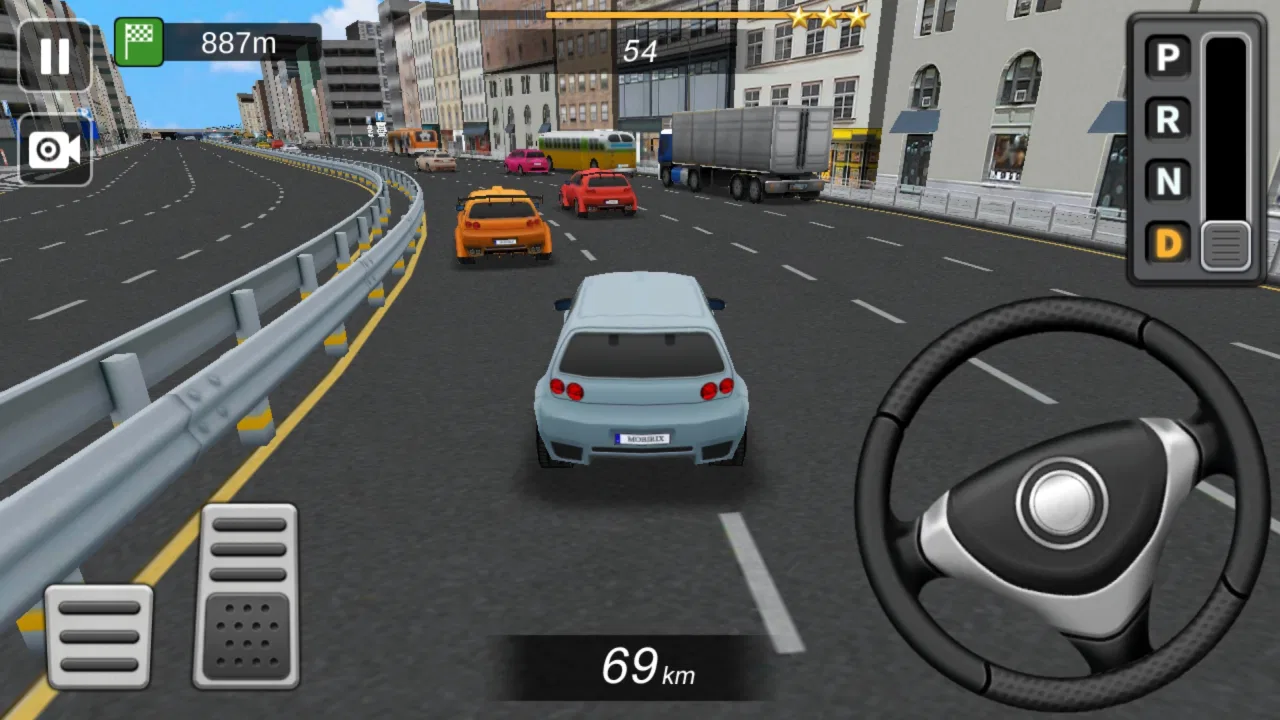
The first thing I notice is how quickly the game communicates its purpose. It presents itself as a road-driving experience, not as a traditional race with a pack of opponents and a finish line dominating every moment. That changes the mood immediately. Instead of chasing a rival through a fixed course, I am watching the road ahead, judging openings, and trying to keep the drive flowing without turning every decision into a reckless gamble.
This makes the opening sessions approachable. I can understand the central challenge without reading a long explanation: stay aware, maintain a useful pace, and avoid letting traffic break my concentration. The controls and road view do most of the teaching. That is a good choice for a phone game because it reduces the distance between launching the app and actually playing.
There is also a quiet tension in the way ordinary traffic becomes the main obstacle. A clear stretch of road invites me to push forward, while a crowded section forces patience. The game does not need a complicated narrative to create pressure. Every vehicle ahead becomes part of a moving puzzle, and the best route is often the one that preserves momentum instead of simply choosing the most aggressive opening.
I would recommend starting with a conservative style rather than immediately trying to drive as fast as possible. On a touchscreen, small mistakes can come from overcorrecting, and learning how much space is needed before changing direction is more useful than chasing a perfect early run. Once the road begins to feel predictable, I can take more risks without making the experience feel random.
Who will enjoy this particular kind of racing?
This is a strong fit for players who like driving games that reward observation. If you enjoy finding a rhythm in traffic, making quick but measured decisions, and improving through cleaner runs, the concept has a satisfying simplicity. It also works well for someone who wants a game that can fill a short break without demanding a large commitment every time it is opened.
It is less suitable for anyone expecting a deep motorsport simulation. The experience is not centered on detailed race strategy, pit decisions, realistic championship structure, or the social competition of a multiplayer racing scene. Players who mainly want drifting, stunts, licensed cars, or dramatic head-to-head events may find the traffic-focused format too restrained.
It is also worth considering the age rating. The Everyone classification makes the game approachable for a broad audience, but that does not mean every player will find the driving challenge equally easy. Younger players may enjoy the clear road-based objective, while experienced racing fans may need to adjust their expectations and treat it as a concentration game rather than a full racing simulator.
How the visual setting communicates its mood
The road is the game’s main visual language. Rather than relying on a large cast of characters or a story-heavy environment, it uses the movement of vehicles and the shape of the route to keep my attention. The setting feels functional, which suits the premise. The scenery exists to frame the drive and help me read what is coming, while the traffic supplies the visual movement that makes each run feel active.
That functional presentation creates a particular mood: alert, contained, and slightly meditative until a difficult gap appears. I am not looking at the road as decoration. I am reading it. A line of vehicles can turn an apparently open stretch into a problem, and the visual flow tells me when to wait, when to move, and when a safe-looking decision may close quickly.
This is one of the game’s more interesting strengths. In many mobile racers, the environment is mainly there to make speed look impressive. Here, the road setting has a more direct mechanical role. It shapes the way I play. The visual composition encourages me to keep scanning ahead instead of staring only at a speed indicator or chasing visual effects.
The trade-off is that players who need constant visual novelty may find the presentation modest. The experience is built around repeated road situations, so its atmosphere comes from changing traffic pressure rather than from a sequence of elaborate locations. I appreciate that consistency, but I would not choose this game for a sightseeing-focused driving experience.
Reading traffic as a playable language
The most useful way to understand the setting is to treat every vehicle as part of a sentence. A slow car changes the meaning of the space ahead. A cluster of traffic suggests that I should prepare earlier. A clear lane gives me room to build confidence, but it can also tempt me into moving faster than my reactions can comfortably support.
This creates a subtle learning process. I begin by reacting to individual cars, then gradually start predicting how groups will affect my options. That shift is important because it makes the game feel less like random swerving and more like planning in real time. The road becomes readable, and improvement comes from seeing situations sooner.
A practical tip is to focus on the next safe decision rather than the most ambitious one. If I constantly aim for the narrowest gap, the game becomes frustrating and my mistakes feel self-inflicted. Leaving a little room often produces a smoother run, and smoothness is more valuable here than a single flashy maneuver.
Sound, timing, and the feeling of motion
The audio atmosphere works best when it supports concentration instead of competing with it. Driving games depend on a sense of forward movement, and sound helps make a short road segment feel active even when the visual setting remains familiar. The overall effect is a focused driving mood rather than the loud, celebratory energy of an arcade race.
I find that this makes the game easier to settle into during routine moments. A quick session after work or during a break can feel like a small reset because the attention required is clear and immediate. I am not managing a large collection or following a complicated plot; I am simply listening to the flow of the drive and responding to what is ahead.
The pacing is especially important. Traffic naturally creates alternating periods of confidence and caution. An open stretch lets me relax into the movement, while a crowded section tightens my attention. That contrast prevents the road from feeling completely flat. The game’s mood comes from the transition between those states, not from constant speed.
Still, this rhythm will not satisfy everyone. If I want a soundtrack-led racer where every moment is loud and dramatic, a more conventional arcade title may be a better choice. Traffic and Driving Simulator is more comfortable with restraint. Its atmosphere is strongest when I allow the road to set the pace instead of demanding nonstop excitement.
Why the calm moments matter
The slower portions are not empty space. They give me time to reset my position and prepare for the next complication. Without that breathing room, traffic would become exhausting rather than engaging. The game benefits from letting the player experience anticipation: I can see a situation developing, decide how much risk is acceptable, and then act.
This also makes the game useful for different moods. When I am tired, I can treat a run as a gentle concentration exercise and avoid unnecessary risks. When I want more intensity, I can push my pace and accept that tighter decisions will demand more attention. The same road-focused design supports both approaches, although the game is always more about control than spectacle.
Where the mechanics fit the atmosphere
The central mechanics and the visual mood support each other because both ask me to stay present. The road is not merely a backdrop for speed; it is the source of the challenge. Traffic gives the game its pacing, and my control decisions determine whether that pacing feels smooth or chaotic.
That relationship is why the title feels more coherent than its simple premise might suggest. The setting says, “watch carefully,” and the mechanics reinforce that instruction. The sound and movement then make each successful passage feel like a small release of tension. I do not need a dramatic victory screen to understand that I handled a difficult sequence well.
One of the less obvious strengths is that the game encourages restraint without making restraint feel passive. Waiting for a better opening is still an active decision. I am managing momentum, position, and risk rather than simply slowing down. That gives cautious play a purpose, which is something many faster racing games overlook.
Another useful insight is that short sessions can be more productive than marathon play. Because the challenge depends on attention, playing while distracted quickly leads to poor decisions. I get more from a few focused runs than from playing for a long time with half my attention elsewhere. It is a good example of a mobile game whose design rewards concentration more than endurance.
Free access and the practical mobile trade-off
The game is free to download, which makes it easy to try before deciding whether its road-focused format suits me. There are in-app purchases ranging from $2.99 to $99.99 per item, so players should approach the optional spending with a clear limit in mind. I would first play enough to understand whether the basic driving loop is enjoyable on its own rather than assuming that purchases are necessary for a good experience.
This matters because the game’s value is mainly in its moment-to-moment driving. If I already enjoy the traffic challenge, optional purchases may feel like a convenience or progression decision. If I do not enjoy judging road gaps, spending more will not solve the fundamental mismatch. The free entry point is therefore useful: it lets the driving itself make the case.
The current version is 1.0.44, and the minimum operating system is Android 7.0. On compatible devices, that gives the game a relatively broad reach, although the exact feel will still depend on the phone’s screen, responsiveness, and performance. A larger display can make road reading more comfortable, while a smaller screen may require more careful control movements.
How it compares with familiar alternatives
Compared with a traditional arcade racer, this game feels less interested in dramatic overtakes and more interested in sustained awareness. Arcade alternatives are usually better when I want jumps, drifting, turbo boosts, or a strong sense of spectacle. They can make a short session immediately exciting, but they may not offer the same calm satisfaction that comes from threading through traffic cleanly.
Compared with a serious simulation, Traffic and Driving Simulator is easier to approach and less demanding in terms of racing knowledge. A full simulation is the better option if I want detailed vehicle behavior, complex track preparation, or competitive motorsport structure. This game is better when I want the idea of realistic road driving reduced to a clear mobile challenge.
It also differs from endless runners that use traffic mainly as something to dodge at extreme speed. Here, the mood is not only about surviving as long as possible. I pay attention to the quality of each decision and the way the road develops. That distinction makes it appealing to players who want a driving game with a more measured pulse.
Everyday situations where it works well
Imagine having ten minutes before an appointment. I can start a run, settle into the road rhythm, and get a complete sense of the game without needing to remember a complicated campaign objective. If I make a mistake, the session still feels useful because I can identify whether I misjudged speed, followed traffic too closely, or moved before the opening was ready.
It can also work during a commute as a passenger, during a quiet break, or at home when I want something more engaging than a passive video but less demanding than a long-form game. I would not play it while walking, driving, or doing anything that already requires visual attention. The game needs focus, even when the session is short.
For families, the Everyone rating makes the concept broadly approachable, but I would still explain the traffic objective to a younger player and encourage patient driving. The most valuable lesson the game offers is not “go faster”; it is “read the road before committing.” That makes it a more thoughtful choice than its simple controls might suggest.
Small habits that improve the experience
I get better results when I keep my movements deliberate. Sudden corrections can turn a manageable situation into a collision, so I try to decide on a line before entering a crowded section. I also avoid treating every open space as an invitation to accelerate. A gap is only useful if I have enough time and room to complete the maneuver comfortably.
Another habit is to use the quieter sections to prepare, not merely to relax. I look farther ahead, notice how traffic is grouping, and choose whether I want to maintain my current pace or create more room. This turns the game from a series of last-second reactions into a sequence of small plans.
Finally, I recommend judging progress by consistency. A run with fewer dramatic moments can be more satisfying than one that includes a risky pass followed by several corrections. The game’s atmosphere rewards a clean flow, and learning to preserve that flow is where much of its replay value comes from.
What may limit long-term appeal
The same focus that makes the game accessible can also narrow its audience. Players who need a strong narrative, extensive customization, or a large variety of race formats may reach the limits of the concept sooner than they would in a broader racing package. The road challenge is clear, but it is not trying to be every kind of driving game at once.
There is also a difference between realistic mood and complete simulation. The game can make traffic feel believable as a challenge without reproducing every detail of real-world driving. That is not a flaw for me, because the simplified design keeps the mobile experience manageable, but players looking for technical authenticity should choose a dedicated simulation instead.
In-app purchases may also affect how comfortable different players feel with the progression experience. Since the game is free to start but offers individual purchases from $2.99 up to $99.99, I would keep spending optional and decide based on enjoyment rather than pressure. The safest approach is to establish a personal budget before buying anything.
My atmosphere verdict
Traffic and Driving Simulator succeeds because its art direction, road setting, sound, and pacing all point toward the same experience: attentive driving through moving traffic. The game does not need an elaborate fictional world to create a mood. Its world is the road, and its language is made from distance, timing, speed, and the changing shape of traffic.
I especially like how the calmer sections support the tense ones. The game gives me enough breathing room to plan, then asks me to prove that plan when the road becomes crowded. That balance makes the experience feel more intentional than a simple reflex challenge. The strongest reason to play is the satisfying rhythm of making careful decisions under light pressure.
My recommendation is clear but specific. Choose it if you want a free mobile racing game centered on road awareness, short focused sessions, and a controlled driving mood. Skip it if your priority is licensed-car collecting, multiplayer competition, dramatic stunts, or deep motorsport simulation. For me, it works best as a compact traffic-driving experience that I can return to when I want movement without noise.
Mobirix has kept the idea easy to understand, and the game’s broad audience reflects that accessibility. Its 4.2 average and more than 10 million installs show that the format has found plenty of players, while the Everyone rating makes it approachable for a wide range of users. I would still try the free version patiently before considering any purchase, because the real question is whether this particular road rhythm matches the way you like to play.
In the end, I see it as a focused alternative to louder, faster racing games. It creates its best moments through anticipation rather than spectacle, and through control rather than constant aggression. When I want a short session that asks me to observe, decide, and keep the drive flowing, this is a game I am happy to recommend.
FAQs for Traffic and Driving Simulator
01What is the main objective of Traffic and Driving Simulator?
Traffic and Driving Simulator aims to provide a realistic driving experience where players can practice and hone their driving skills in various scenarios. The game simulates real-world traffic conditions, allowing users to navigate through different environments, follow traffic rules, and complete driving challenges to improve their proficiency.
02Does Traffic and Driving Simulator offer different vehicle options?
Yes, Traffic and Driving Simulator offers a wide range of vehicle options. Players can choose from various cars, including sedans, SUVs, and sports cars, each with unique handling characteristics. The game also offers customization options, allowing players to modify their vehicles for better performance and aesthetics.
03Is Traffic and Driving Simulator available offline?
Traffic and Driving Simulator offers both online and offline modes. While you can enjoy the basic driving experience offline, connecting online provides additional features such as multiplayer modes, leaderboards, and regular updates with new content and challenges. An internet connection enhances the overall gaming experience.
04What features make Traffic and Driving Simulator realistic?
The game incorporates advanced physics and graphics to create a realistic driving experience. Features include lifelike traffic patterns, weather changes, day-night cycles, and detailed urban and rural environments. The sound design, with engine noises and ambient sounds, further enhances the immersion into real-world driving scenarios.
05Are there any educational benefits to playing Traffic and Driving Simulator?
Yes, Traffic and Driving Simulator can be educational by helping players learn and practice traffic rules and safe driving habits. The game provides scenarios that teach defensive driving techniques, parking skills, and road sign recognition, making it a useful tool for new drivers looking to improve their real-world driving skills.
Pros
- Realistic driving physics enhance immersion.
- Wide variety of vehicles to choose from.
- Dynamic weather conditions add challenge.
- Detailed city environments for exploration.
- Intuitive controls make gameplay accessible.
Cons
- Occasional lag on lower-end devices.
- In-app purchases can be expensive.
- Limited customization options for vehicles.
- Some AI drivers behave unrealistically.
- Frequent ads can disrupt gameplay.

Traffic and Driving Simulator
Gallery